
LONGYI · CPC-SS SERIES · MADE IN TAIWAN
Dicing Chuck TablePorous Ceramic Vacuum Table for Saw & Laser Dicing
The porous ceramic vacuum table that holds a wafer — mounted on dicing tape and a frame — flat and still while it is cut into individual dies. Vacuum is drawn evenly through thousands of micro-pores, so the wafer is supported edge to edge instead of gripped at a few holes: the cut line stays stable, front- and back-side chipping and die shift drop, and thin or fragile wafers come through the full cutting cycle intact.
A dicing chuck table is a porous ceramic vacuum table that holds a taped-and-framed wafer flat during saw or laser dicing. Vacuum spread evenly through micro-pores backs the whole wafer, so cuts stay clean and dies do not shift or chip. LONGYI supplies them as OEM-compatible replacements and custom builds — matched to your dicing saw or grinder from a drawing, sample or worn part — in 6″, 8″, 12″ round plus square and oblong shapes, with an optional anti-static (ESD) grade at 10⁶–10⁹ Ω.
One Porous Ceramic, Engineered for Each Station
The dicing chuck table is the family member built for singulation. The rest are tuned for wafer handling, grinding, machining and air bearings.
How We Build Your Dicing Chuck Table
Scroll through the five decisions behind every OEM-compatible or custom table.
Your Saw & Interface
We start from your dicing saw, laser dicer or grinder: outline, mounting interface, vacuum-zone layout and thickness are matched to the stage the table drops into.
Wafer & Frame Format
Round 6″, 8″ and 12″ as standard, plus square and oblong (racetrack) tables for panel formats, square frames and special stage layouts — 2″ to 12″ on request.

Pore Grade & Flatness
Pore grade and flatness are matched to the substrate and its thickness, giving a precision-ground reference plane for stable, repeatable cutting.

Standard or Anti-Static
Standard porous ceramic for most wafers; the ESD grade bleeds charge away at 10⁶–10⁹ Ω for logic, memory, MEMS and sensor devices or cleanroom automation lines.

Build, Measure — or Recondition
Every table is ground after assembly and its flatness measured before shipping. Worn or clogged chucks can often be re-ground back to specification instead of replaced.
01 / 05
CPC-SS Series — Porous Ceramic on Stainless Steel
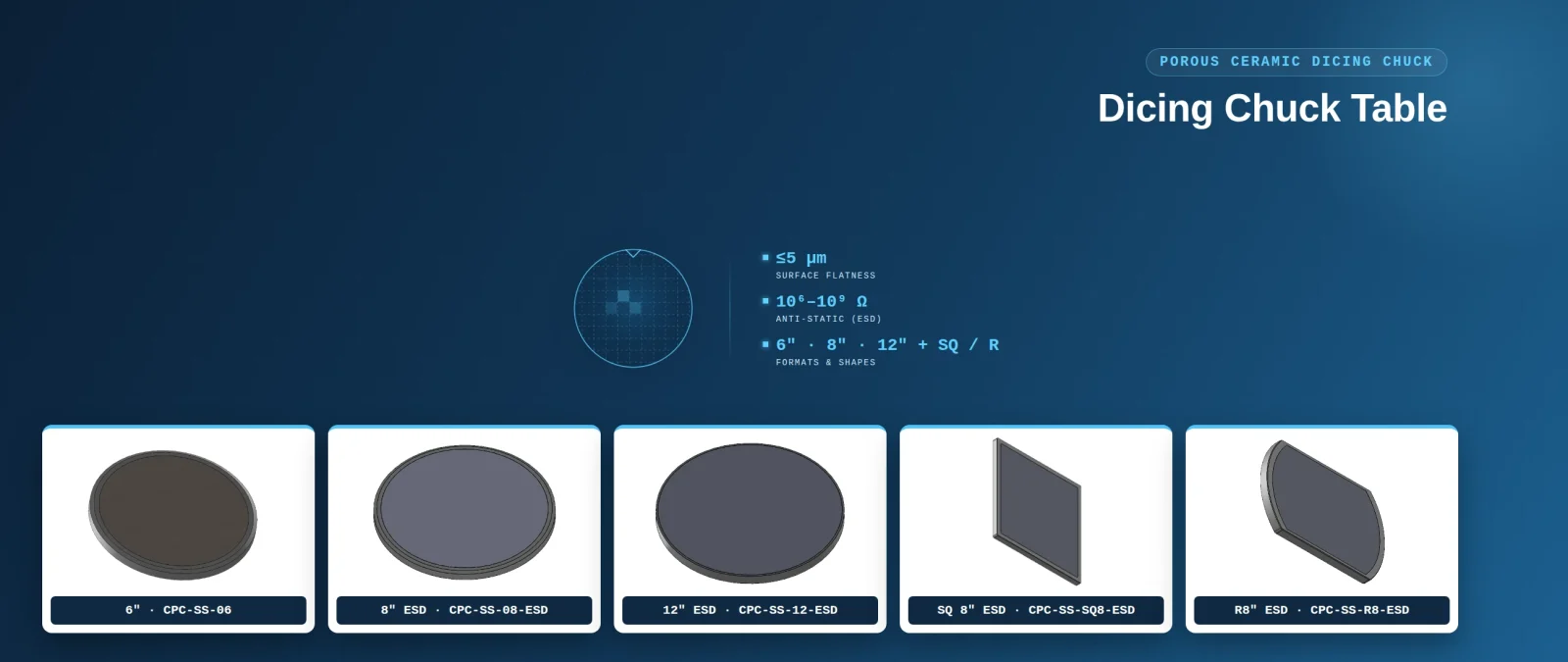
Five standard configurations cover the common wafer sizes and dicing-frame shapes. All share the porous ceramic suction top on a stainless-steel base; the ESD suffix marks the anti-static grade.
6″ ROUNDCPC-SS-06
Six-inch round porous ceramic dicing table for standard 150 mm wafer singulation.
8″ ROUND · ESDCPC-SS-08-ESD
Eight-inch round anti-static table for 200 mm dicing of ESD-sensitive devices.
12″ ROUND · ESDCPC-SS-12-ESD
Twelve-inch round anti-static table for 300 mm wafer dicing and singulation.
SQUARE 8″ · ESDCPC-SS-SQ8-ESD
Square 8-inch anti-static table for panel-format substrates and square dicing frames.
OBLONG 8″ · ESDCPC-SS-R8-ESD
Oblong (racetrack) 8-inch anti-static table for elongated frames and special stage layouts.
Model Selection
| Model | Shape | Wafer / Format | Base Frame | Anti-Static (ESD) |
|---|---|---|---|---|
| CPC-SS-06 | Round | 6″ (150 mm) | Stainless Steel | — |
| CPC-SS-08-ESD | Round | 8″ (200 mm) | Stainless Steel | ✓ |
| CPC-SS-12-ESD | Round | 12″ (300 mm) | Stainless Steel | ✓ |
| CPC-SS-SQ8-ESD | Square | 8″ square format | Stainless Steel | ✓ |
| CPC-SS-R8-ESD | Oblong (racetrack) | 8″ elongated format | Stainless Steel | ✓ |
Naming: CPC = Ceramic Porous Chuck · SS = Stainless-Steel base · number = wafer size · SQ = square · R = oblong/racetrack · ESD = anti-static grade. Sizes from 2″ to 12″ and non-standard outlines are available on request. Square and oblong outlines are shown for illustration.
Supported Wafers & Typical Applications
The table is configured to the substrate you cut — pore grade, flatness and vacuum pattern are matched to the material and thickness.
Supported wafer materials
Typical applications
Specifications, Materials & Compatibility
Values are representative; actual specifications are set to your process, wafer and equipment requirements.
| Specification | Details |
|---|---|
| Product Type | Porous Ceramic Dicing Chuck Table |
| Suction Surface | Porous Ceramic (PC) — insulative; Anti-Static (ESD) grade optional |
| Base Frame | Stainless Steel (SS) |
| Wafer Sizes | 6″, 8″, 12″ standard · 2″–12″ on request |
| Shapes | Round, square, oblong (racetrack), custom outline |
| Surface Flatness | ≤ 5 µm (typical, configurable) |
| ESD Resistivity | 10⁶–10⁹ Ω (ESD grade) |
| Vacuum | Uniform micro-pore vacuum adsorption |
| Surface Finish | Precision ground |
| Custom Design | Available — OEM/ODM, build from drawing or sample |
Porous Ceramic
High-rigidity microporous ceramic with fine, uniform pores — the flattest holding surface and the most even suction. The standard grade for stable, low-chipping dicing (CPC-SS-06).
Material data → ATCAnti-Static Ceramic
Porous ceramic tuned to 10⁶–10⁹ Ω surface resistivity to dissipate static charge safely — used on the ESD models for ESD-sensitive devices and cleanroom dicing automation.
Material data →Equipment Compatibility & Custom Builds
Equipment names are trademarks of their respective owners and are listed only to indicate compatibility. Confirm the exact platform and interface with our engineers.
What Changes at the Dicing Saw
LONGYI supports dicing customers with product selection, equipment-compatibility assessment, custom OEM/ODM manufacturing, reconditioning of worn tooling and responsive engineering support — from a single replacement chuck to a full production set.
Improves wafer stability
Full-surface backing keeps the wafer flat and located through the cut.
Reduces chipping & cracking
Even support at the kerf limits front- and back-side edge damage.
Minimizes die shift
Dies stay in position as the tape is severed.
Raises process repeatability
A stable, flat reference plane, cut after cut.
Supports higher yield
Fewer defects from movement, chipping or static damage.
Extends tooling life
Worn chucks can be reconditioned instead of replaced.
Wafer size or frame shape, dicing method (saw or laser), equipment model and whether ESD is required — or a sample chuck to copy or recondition.
Measured by the Customer, Proven in the Cut
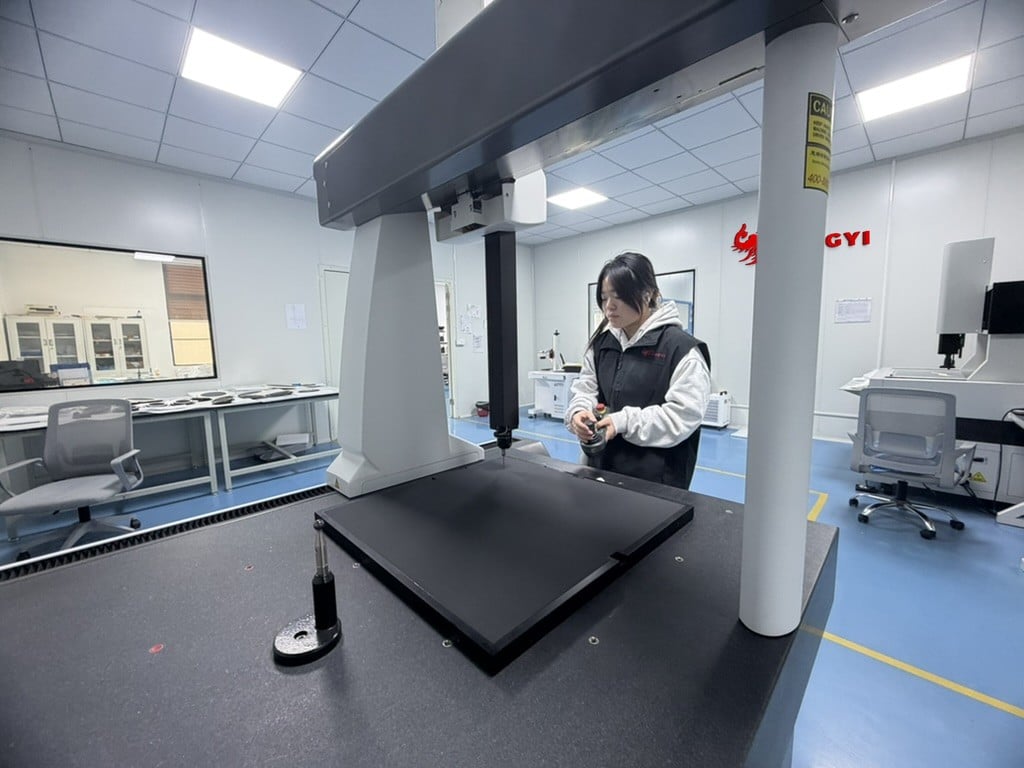
A customer measuring a LONGYI chuck table on their own dicing saw — and a 100 µm ultra-thin cut on a porous ceramic vacuum chuck.
Dicing Saw Table — Client Measures Vacuum Flatness
A client measures the flatness of a LONGYI ceramic vacuum chuck table mounted on their own dicing saw. The high-vacuum ceramic surface holds wafers stable for dicing and is compatible with DISCO and ADT machines. Dimensions, vacuum zones, and hole layout are all customizable to your equipment.
Cutting 100 µm Ultra-Thin Material — No Blue Liner
A porous ceramic vacuum chuck holds and cuts 100 µm ultra-thin material without a blue liner. Uniform micro-pore suction keeps the whole surface flat and stable, so thin substrates cut cleanly with minimal deformation — for semiconductor and advanced-packaging (FOPLP, CoPoS) work, with anti-static performance for sensitive devices.
Dicing Chuck Table FAQ
Common selection, compatibility and process questions from dicing and packaging engineers.
01What is a dicing chuck table?
A dicing chuck table is a porous ceramic vacuum table that holds a taped-and-framed wafer flat during saw or laser dicing. Vacuum spread evenly through micro-pores backs the whole wafer, so cuts stay clean and dies do not shift or chip. LONGYI supplies them as OEM-compatible replacements and custom builds in 6″, 8″ and 12″ round plus square and oblong shapes, with an optional anti-static (ESD) grade.
02Why use a porous ceramic dicing chuck instead of a grooved or single-hole table?
Because vacuum is spread evenly through thousands of micro-pores, the whole wafer is backed and held flat right up to the cut line. A grooved or single-hole table only grips at a few points, so unsupported areas can vibrate or lift during dicing, leading to chipping and die shift. Uniform micro-pore support keeps the kerf stable and the dies in place.
03Can you match my dicing saw, or build from a sample or worn chuck?
Yes. We build OEM-compatible and custom tables from your drawing, a physical sample or a worn part — matching the outline, vacuum-zone layout, thickness and mounting interface. This covers common dicing saws (DISCO, K&S, ADT and equivalents), laser dicers and grinders, including legacy or discontinued tooling.
04Do you recondition worn or damaged chucks?
Yes. Worn, clogged or damaged chucks can often be re-ground and re-worked back to specification instead of being replaced — restoring flatness and vacuum performance at lower cost. Send us the part and we will assess whether reconditioning or a new build is the better option.
05Which wafer materials and sizes are supported?
Silicon, sapphire, GaAs, SiC, GaN, glass substrates and dummy/prime wafers are all supported. Standard formats are 6″, 8″ and 12″ round, with 2″–12″ and custom square or oblong outlines available. Pore grade and flatness are matched to the material and thickness.
06When do I need the ESD (anti-static) grade?
Choose the ESD grade when the devices are static-sensitive — most logic, memory, MEMS and sensor wafers — or when dicing runs inside a cleanroom automation line. The 10⁶–10⁹ Ω surface bleeds off charge safely instead of letting it build up and discharge into a die. For non-sensitive parts, the standard grade is sufficient.
07Does the porous surface get cut or clogged during dicing?
The wafer sits on dicing tape and a frame, so the blade cuts the tape, not the ceramic — the porous surface supports from underneath and is not scored in normal use. Debris and coolant are handled by routine flushing; pore grade is chosen so the surface clears easily and holds suction over long production runs.
Why Choose LONGYI
LONGYI is an advanced-ceramic manufacturer supplying porous ceramic vacuum tooling and precision ceramic components for the semiconductor and optoelectronic industries.
Also Known As
Depending on the equipment maker, process or region, this component is referred to by several names. They generally describe the same porous ceramic vacuum table that holds a taped-and-framed wafer flat during saw or laser dicing:
Need a Dicing Chuck Table Built to Your Wafer and Equipment?
Our engineers will spec a porous ceramic dicing chuck for your process — or copy and recondition the one you already have.
