
Porous Ceramic Air Bearings — Frictionless, Self-Aligning Motion on a Film of Air
LONGYI makes flat aerostatic air bearing pads from its own porous alumina ceramic. Compressed air escapes evenly through the whole bearing face, so the carriage floats on a thin air film instead of sliding on a rail — no stick-slip, no wear, no oil.
A porous ceramic air bearing is a flat aerostatic pad whose porous alumina face emits a uniform air film, so the moving part never touches the guide surface. Standard Ø50 / Ø60 / Ø70 mm round pads, flatness 0.002 mm, parallelism 0.005 mm, self-aligning on a ball pivot — add more pads to carry more load.
Float the Carriage, Don't Slide It
Watch the same carriage move on two guides. On a contact rail it has to break friction before it moves, so it creeps forward in small jumps and wears the rail. On porous ceramic air bearings — the principle of an air bearing slide — it lifts onto an air film only a few microns thick and glides, as smoothly at walking pace as at full speed.
Rolling or sliding contact on a rail
Robust and inexpensive, and fine for most machines. But every move starts by breaking static friction, so slow or reversing motion arrives in small jumps (stick-slip). Contact also wears the rail, warms the guide and sheds particles — accuracy slowly drifts over the life of the machine.
A film of air carries the load
Compressed air leaves through every micro-pore of the ceramic face, so the pad never touches the guide. With nothing to break loose, motion starts and reverses smoothly; with no contact there is no wear, almost no friction heat and nothing to lubricate. The air film also averages out small guide-surface irregularities.
Part of the Porous Ceramic Chuck Family
Draw air in through our porous ceramic and it holds a wafer flat; push air out and it floats a carriage. The air bearing is the same material as our vacuum chucks, with the airflow reversed.
How We Define Your Air Bearing
Scroll through the five decisions our engineers work through with you before the pads are made.
Motion, Load & Guide Surface
What moves, how heavy it is, along which axis and how fast — and what it rides on: granite, ceramic or a machined guideway. Load and the stiffness you need set everything that follows.
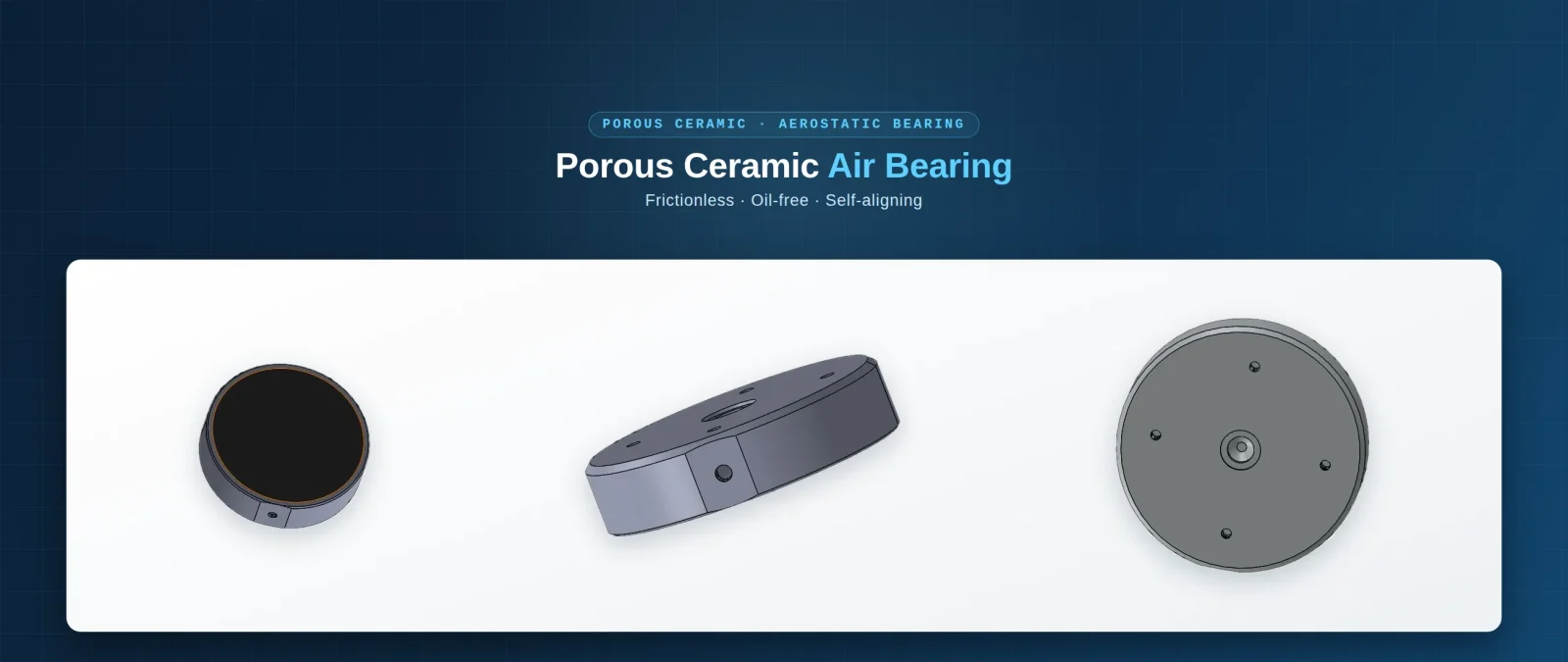
Pad Size & Mounting
Standard Ø50, Ø60 and Ø70 mm round pads, 15.1 mm thick. Each sits on a central Ø8 mm ball-pivot seat, with M4 holes for two or four push screws — or a custom diameter and interface built to your drawing.
The Porous Face
The bearing face is porous alumina (Al₂O₃ 96%) with interconnected 3–5 μm pores at 40–45% porosity, so air leaves through the whole area instead of a few orifices that can clog.
Pad Layout & Air Supply
Every pad simply blows air. Pads facing each other across the beam hold the carriage centred, and load capacity grows with the number of pads. We lay out pad count, brackets and air fittings with you.
Flatness & Verification
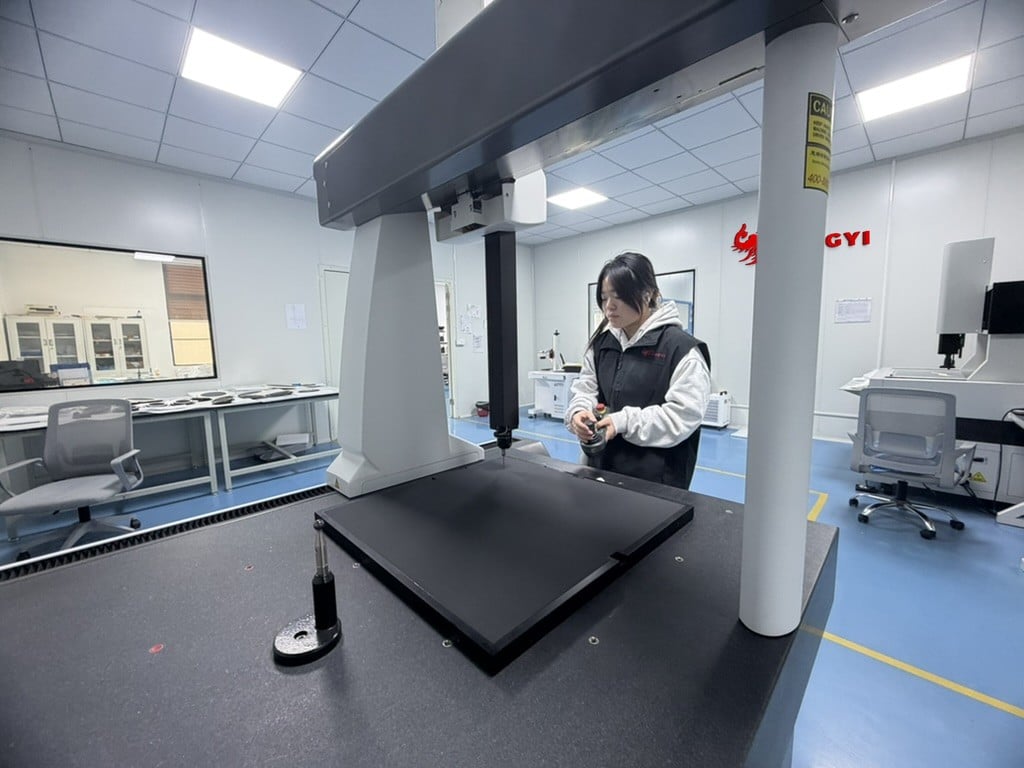
The bearing face is finished to 0.002 mm flatness and 0.005 mm parallelism, and every critical dimension is measured before the bearing ships.
 01 / 05
A Porous Face on a Dense Ceramic Frame
Two alumina ceramics, each doing one job: the porous face spreads the air, the dense frame keeps the geometry. Neither is metal, so there is nothing to fatigue or creep under continuous duty.
Porous Alumina Bearing Face
Interconnected micro-pores let air pass evenly across the whole face, forming a stable, high-stiffness air film with no single orifice to clog.
Dense Alumina Frame
Many air bearings use a metal frame. Alumina is far more dimensionally stable, so the bearing holds its geometry through 24/7 operation without stiffness fatigue or slow creep.
| Technical Item | Specification |
|---|---|
| Product type | Flat, self-aligning porous ceramic air bearing (aerostatic bearing) |
| Standard sizes | Ø50 / Ø60 / Ø70 mm outer diameter · custom to order |
| Bearing face | Porous ceramic, Al₂O₃ 96% (C#-200 / B-200), black |
| Frame | Alumina 99.5% |
| Porosity / pore size | 40–45% / 3–5 μm |
| Flatness / parallelism | 0.002 mm / 0.005 mm |
| Thickness | 15.1 mm |
| Bending strength | > 6 kgf/mm² (≈ 59 MPa) |
| Bulk density / water absorption | 2.28 g/cm³ / 0% |
| Mounting & air feed | Central Ø8 mm ball-pivot seat · M4 holes for 2 or 4 push screws · M4 side air port |
Why Porous Ceramic Instead of Graphite?
Other grades can be evaluated for stiffness, chemical or ESD needs — high-purity alumina or Silicon Carbide (SiC).
Send us the moving mass, the axis, the guide surface and the air supply you have — our engineers will propose pad size, count and layout.
Built to Seat Itself and Fit Your Stage
Three details that decide whether an air bearing works on the first set-up or needs hours of shimming.
 SELF-ALIGNING
Ball pivot + 2 or 4 push screws
A ball in the central Ø8 mm seat works as a universal joint: the round pad swivels in any direction and seats itself parallel to the guide — no manual squaring.
Two or four screws around it then push the face to fine-tune, closing any one-sided gap so air leaves evenly all the way round.
▶ See how pads become an air slide LOW PROFILE
15.1 mm body with a side air port
Compressed air enters through an M4 side port and diffuses through the porous ceramic to exhaust evenly around the full circle.
The low-profile body fits between a carriage plate and a granite surface where space is tight.
 CUSTOM BUILD
Pad count, size & porting to drawing
Custom outer diameter, thickness, porosity, air porting and adapter brackets — from a drawing or a sample.
Need more load? Use more pads. Matched sets for a complete linear, XY or gantry stage are built and measured together.
Seat each pad evenly — then build the slide around your rail.
An air bearing slide floats a carriage on air films only a few microns thick, with no contact at all. Integrated square slides come with one fixed load rating; with LONGYI round pads you place as many as the load needs, each self-aligned on a ball pivot and trimmed with two or four push screws.
Every stage is different. How many pads and which porting depend on the moving mass, the axis and the guide surface. Send us the stage concept or the drawing — we will tell you what applies before quoting.
Air Bearings in Motion
From a carriage pushed along a rail by hand to a 3D animation of pads floating a carriage on a granite beam.
Air Bearing Slide: Frictionless Linear Motion Test
A LONGYI porous ceramic air bearing carriage pushed along a rail by hand, with a dial indicator riding on the assembly. Watch how little force starts it and how smoothly it stops — a contact bearing has to break static friction before it moves at all.
Porous Ceramic Air Bearing FAQ
The questions motion-stage and metrology engineers ask most often when specifying air bearing pads.
01What is a porous ceramic air bearing?
It is a flat aerostatic bearing pad whose working face is porous alumina ceramic. Compressed air fed into the pad leaves through the interconnected micro-pores of the whole face and forms a thin, uniform air film, so the carriage or workpiece floats without touching the guide surface.
Because there is no contact, there is no stick-slip, no wear and no lubricant — which is why air bearings are used on precision stages, metrology machines and wafer inspection equipment.
02How is it different from a porous ceramic vacuum chuck?
It is the same family of porous ceramic with the airflow reversed. A vacuum chuck draws air in through the pores to hold a wafer down; an air bearing pushes air out through the pores to lift a carriage on an air film.
03Why porous ceramic instead of porous graphite?
Porous alumina ceramic offers higher stiffness, better wear and corrosion resistance and greater thermal stability than porous carbon / graphite. That suits the cleanliness and precision demands of semiconductor and metrology equipment, and the ceramic face resists damage on accidental contact.
04What does the self-aligning ball pivot do?
A ball in the central Ø8 mm seat works as a universal joint: it fixes the pad at its centre while letting the round face swivel in any direction and seat itself parallel to the guide. Two or four push screws around it then fine-tune the tilt so the air gap — and the air leaving it — is uniform 360°, with no single-side leakage or friction.
05Why is the frame 99.5% alumina instead of metal?
Many air bearings use a metal frame. Under 24/7 continuous operation metal is prone to stiffness fatigue and slow dimensional creep, so positioning error accumulates over time. LONGYI builds the frame from 99.5% alumina, which holds its geometry and accuracy through long, continuous duty.
06What sizes are available, and can it be customized?
Standard outer diameters are Ø50, Ø60 and Ø70 mm at 15.1 mm thick. Diameter, thickness, porosity, material, air porting, brackets and pad count can be built to your drawing or sample.
07What flatness and parallelism can you hold?
The standard bearing face is finished to 0.002 mm flatness and 0.005 mm parallelism, and every critical dimension is measured before shipping. Tighter values can be discussed for specific applications.
08Does it need oil or lubrication?
No. The bearing runs on compressed air with no contact, so it is oil-free and particle-free and suits cleanroom equipment. Keep the supply air clean and dry — oil or water carried in the air would gradually fill the pores.
09Why can motion be straighter than the guide surface?
The air film covers the whole pad area, so small irregularities in the guide surface are averaged out instead of being followed point by point. Combined with near-zero friction and no stick-slip, this gives low velocity ripple — useful for scanning, coating, dispensing and inspection motion.
10What is an air bearing slide?
An air bearing slide (also called an air-bearing guide or aerostatic guideway) supports and guides a carriage on a thin film of compressed air — typically a few microns to around ten microns thick — instead of balls or rollers. Nothing touches, so there is no friction to break, no wear and no lubricant, and it is commonly paired with a granite base and a linear scale for sub-micron positioning.
With LONGYI round pads, the slide is built by mounting pads on every face of the guide beam, each simply blowing air.
11Integrated square air slide or modular round pads?
An integrated square slide comes as one housing with one fixed load rating. Modular round pads are placed on your own carriage, so load capacity grows with the number of pads — two, four, six or more — and the layout follows your machine rather than a catalogue size.
We supply standard pads, or design the complete pad set and brackets as OEM / ODM. OEM & ODM →