
Anti-Static Ceramic (ATC) — ESD-Safe Ceramic Components for Wafer & Die Handling
10⁷–10⁸ Ω·cm ESD-Dissipative Range · 抗靜電陶瓷 · LONGYI grades ZOB56 / SCB316 / PS Series
Anti-static ceramic — also called ESD ceramic or static-dissipative ceramic — is not a separate material family so much as a resistivity target that several advanced and technical ceramics can be engineered to meet. LONGYI Precision Technology supplies three existing grades that already land in the 10⁷–10⁸ Ω·cm dissipative window: ZOB56, a black zirconia grade for high-strength ESD fixtures; SCB316, a black silicon carbide grade for rigid, large-format handling parts; and a porous silicon carbide series (PS03–PS30) that combines ESD resistivity with through-body vacuum. All three are produced and machined in-house in Taiwan as an OEM / ODM manufacturer, not resold.
Material at a Glance
Anti-static ceramic solves ceramic's one built-in flaw.
A standard advanced ceramic is deliberately made as insulating as possible — alumina and most of the LONGYI range sit above 10¹⁴ Ω·cm — and against a bare die or a wafer that is exactly the wrong property: static charge generated by contact and separation has nowhere to go, and once it reaches breakdown it releases in a single damaging event instead of bleeding away. LONGYI's anti-static grades hold volume resistivity down in the 10⁷–10⁸ Ω·cm dissipative range instead, while keeping full ceramic hardness, stiffness and zero particle generation — something neither a metal fixture (scratches, magnetises) nor a plastic one (wears, outgasses, deforms under load) can match. We do not run one dedicated ESD formulation; we offer three existing grades that already land in that window — ZOB56 (zirconia, 710 MPa), SCB316 (silicon carbide, 23 GPa hardness) and the PS series (porous silicon carbide, vacuum-capable) — so the mechanical profile is matched to the part, not the other way around.
How ATC Grades Compare Across the Full Material Range
These four properties place all three ESD grades against LONGYI's other material families. Read the resistivity bar first — it is the property that defines this page.
Bars show where the three ATC grades sit against LONGYI's other material families. Markers are spaced evenly by rank, not to linear scale. *Boron nitride's 1800–2100°C figures are inert-atmosphere values; in air BN is limited to 900–1000°C. Representative grades: Anti-Static = ZOB56 / SCB316 / PS03–PS30 · Silicon Carbide = SCB32 · Zirconia = ZOI60 · Alumina = AOW37 / AOI38 · Boron Nitride = CRVT-BN-H / CRVT-BN-S · Aluminum Nitride = ANG34 · Machinable = BN-T2300. Values from LONGYI internal property testing and the LONGYI porous ceramic performance table (PS series, 2026-09).
ATC Grade Properties
Three existing material families, each engineered into the ESD-dissipative resistivity window. Typical values from LONGYI internal testing.
| Property | ZOB56Zirconia-based · Black | SCB316SiC-based · Black | PS SeriesPorous SiC-based · PS03–PS30 |
|---|---|---|---|
| Physical | |||
| Bulk Densityg/cm³ | 5.6 | 3.16 | 2.5–2.8 |
| Porosity% | 0 (dense) | 0 (dense) | 35–40 |
| Mechanical | |||
| HardnessHV1 GPa / HRA | 10.8 (HV1) | 23 (HV1) | 58–65 (HRA) |
| Flexural StrengthMPa | 710 | 450 | 260–280 |
| Compressive StrengthMPa | 1850 | 3900 | 2300–2500 |
| Young's ModulusGPa | 210 | 440 | 260–280 |
| Fracture ToughnessMPa·m½ | 3–4 | 2–3 | — |
| Thermal | |||
| Thermal Expansion 40–400°C×10⁻⁶/°C | 10.3 | 3.7 | 5.6–5.8 |
| Thermal Conductivity 20°CW/(m·K) | 3 | 50 | 1.3–2.7 |
| Max Use Temperature°C | 1600 | 1600 | 1400–1500 |
| Electrical | |||
| Volume Resistivity 20°CΩ·cm | 10⁸ | 10⁸ | 10⁷ |
| Dielectric / Breakdown StrengthkV/mm | — | — | 16 (DC) |
| Process Capability | |||
| Filtration Vacuum DegreeMPa | — | — | ≥ -0.08 |
Values are typical for the stated grade, drawn from LONGYI's zirconia, silicon carbide and porous ceramic property data — see the respective material pages for the full grade families each is drawn from. The PS Series spans grades PS03–PS30 (1–30 µm pore size); the range shown covers the full series. Hardness is reported in the scale each source table uses (Vickers HV1 for ZOB56 / SCB316, Rockwell HRA for the PS series) — the two scales are not directly convertible and should be treated as separate figures. A dash (—) means the property has not been measured for that grade, not that it is zero. Final part specification is governed by the approved drawing and order confirmation.
Which ESD Grade Do You Need?
The highest-strength ESD option. Built on the same 99% zirconia body as our structural ZOI60 grade, ZOB56 trades some flexural strength for the doping that pulls resistivity down to 10⁸ Ω·cm — 710 MPa is still more than double SCB316's 450 MPa. Choose it for thin, slender or shock-loaded ESD fixtures that would otherwise chip.
- Flexural710 MPa
- Hardness10.8 GPa
- Resistivity10⁸ Ω·cm
The stiffest, hardest ESD option. Same 99.8% SiC body as our structural SCB32 grade, with resistivity brought down into the dissipative range at the cost of some flexural strength (450 vs 540 MPa) and toughness (2–3 vs 4–5 MPa·m½). Choose it for large-format handling arms and end effectors where deflection, not chipping, is the risk.
- Flexural450 MPa
- Hardness23 GPa
- Resistivity10⁸ Ω·cm
The only option that also pulls vacuum. A porous silicon carbide body (35–40% porosity, 1–30 µm pore grades) that lands one order of magnitude more conductive than the other two, at 10⁷ Ω·cm, while pulling vacuum evenly across the whole working face (≥ -0.08 MPa). The trade-off is strength — 260–280 MPa, the lowest of the three. Choose it for ESD vacuum chucks and stages, not structural fixtures.
- Flexural260–280 MPa
- Resistivity10⁷ Ω·cm
- Vacuum Degree≥ -0.08 MPa
All three sit inside the same ESD-dissipative window; none of them is a general-purpose insulator. Pick by mechanical and process requirement, not by resistivity — the resistivity is already decided.
Where Anti-Static Ceramic Is Used
Wafer & Substrate Handling
- Wafer transfer arms and end effectors
- IC carrier trays and pick-up nozzles
- Panel and OLED handling components
Test, Inspection & Cleanroom Tooling
- Probe card and test socket components
- Dicing and grinding process fixtures
- Cleanroom jigs and fixtures
Assembly & Production Tooling
- Battery and electronic component assembly fixtures
- ESD vacuum chucks and stages (PS series)
- Static-sensitive handling jigs
When Anti-Static Ceramic Is the Wrong Choice
We would rather tell you the limits up front than have you pay for ESD resistivity you don't need. Each of these is a real boundary in the data above.
If the part never touches a wafer, a bare die or another static-sensitive component, the ESD grades cost extra for a property you won't use. A standard alumina insulator is cheaper, or for higher strength in the same zirconia family, our structural zirconia (ZOI60) reaches 1000 MPa flexural strength against ZOB56's 710 MPa.
For high-voltage isolation or a hermetic feedthrough, resistivity has to go the other direction. ATC grades are deliberately semi-conductive at 10⁷–10⁸ Ω·cm — use alumina or aluminum nitride instead, both >10¹⁴ Ω·cm.
None of the three ATC grades is a thermal-management material — SCB316's 50 W/(m·K) is the best of the three, and ZOB56 and the PS series sit far below it. Where a die or heater has to shed heat through the ceramic, aluminum nitride at 220 W/(m·K) is the answer.
If the part needs to pull vacuum across its face but never touches anything static-sensitive, the alumina-based side of porous ceramic (PA series, 10¹³–10¹⁴ Ω·cm) gives near-insulating resistivity and a wider strength range (200–300 MPa) than the SiC-based PS series used here.
Bringing resistivity down costs some strength in both base materials — SCB316 gives up 90 MPa of flexural strength against structural SCB32, and ZOB56 gives up 290 MPa against ZOI60. Where the part is purely structural and never sees static-sensitive material, the non-ESD grade of silicon carbide or zirconia is the stronger choice.
Parts We Make in Anti-Static Ceramic
ESD grades are used where LONGYI parts contact a wafer, panel or bare die directly.
From Material to Finished Part
Choosing an ESD grade is the easy half. Whether the geometry can actually be produced — and held to tolerance — depends on forming, sintering, grinding and measurement.
Advanced Ceramics Manufacturing
ZOB56 and SCB316 parts are formed, sintered and diamond-ground to final tolerance like any dense structural ceramic; the PS series is fired to a controlled open-pore structure instead of full density, so the process trades sintering density for the porosity and vacuum path the part needs.
See our manufacturing processAbout LONGYI Precision Technology
We are a Taiwan-based advanced ceramic manufacturer, not a trading house. Forming, sintering, CNC and 5-axis machining, brazing, metallization and final inspection are handled in-house, which is what makes true OEM / ODM work — build to drawing, build to sample — practical at low volume.
About LONGYI Precision TechnologyNot Sure Which ESD Grade Fits Your Part?
Send a drawing, or describe the geometry and what the part will touch. Our engineers will come back with a grade recommendation and a quotation.
Talk to Our EngineersFrequently Asked Questions
What is Anti-Static Ceramic (ATC)?
Anti-static ceramic (ESD ceramic) is a ceramic engineered to hold a mid-range volume resistivity — roughly 10⁷–10⁸ Ω·cm — instead of the >10¹⁴ Ω·cm of a standard insulating ceramic, so static charge generated by contact with a wafer or a bare die bleeds away continuously instead of releasing in a single damaging discharge. LONGYI does not run a single dedicated ESD grade; we supply three existing material families — a zirconia grade (ZOB56), a silicon carbide grade (SCB316) and a porous silicon carbide series (PS03–PS30) — that already fall in that dissipative window, so you can pick the one whose mechanical and thermal profile fits your part.
Is "technical ceramics" the same as "advanced ceramics"?
Yes. Advanced ceramics, technical ceramics and fine ceramics are three names for the same family of engineered materials — advanced ceramics in North America and Taiwan, technical or engineering ceramics in Europe, and fine ceramics in Japan. The term changes with the region, the material does not.
Which ESD ceramic should I choose — ZOB56, SCB316 or the PS series?
Start from the mechanical requirement, not the resistivity — all three sit in the same 10⁷–10⁸ Ω·cm dissipative window. ZOB56 gives the highest flexural strength at 710 MPa, best for thin or slender ESD fixtures. SCB316 gives the highest stiffness and hardness at 440 GPa / 23 GPa, best for large, rigid handling parts. The PS series is the only one of the three that can also pull vacuum across its working face, at the cost of lower strength (260–280 MPa) — choose it when the part is a chuck or a table, not a structural fixture.
What's the difference between anti-static ceramic and a standard insulating ceramic?
Only the resistivity, not the base material class. A standard technical ceramic such as alumina is deliberately made as insulating as possible, at >10¹⁴ Ω·cm — fine for high-voltage isolation, but a liability against a wafer or bare die, where charge has nowhere to go until it releases all at once. ATC grades are the same class of dense technical ceramic, formulated to sit in the 10⁷–10⁸ Ω·cm range instead, so charge dissipates continuously.
Can an ATC material also pull vacuum?
Only the PS series. ZOB56 and SCB316 are fully dense, so vacuum has to be applied through drilled holes or machined grooves, same as any dense ceramic. The PS series is a porous silicon carbide body (filtration vacuum degree ≥ -0.08 MPa) that pulls vacuum evenly across its entire working face while still sitting in the ESD range — that combination is why it is the default choice for ESD vacuum chucks and stages.
Do you offer a dedicated Anti-Static Ceramic grade?
Not as a fourth, separate material — we build ESD tooling from the three existing grades above rather than inventing a new formulation, because all three already land in the dissipative window with known, tested mechanical data. If your application needs a resistivity or a mechanical property none of the three covers, tell us the target and we will confirm whether it is achievable.
What resistivity should I specify for ESD-safe tooling?
Confirm which value your process spec calls out — surface resistivity and volume resistivity are not interchangeable. Our three grades' bulk volume resistivity of 10⁷–10⁸ Ω·cm falls inside the dissipative range most ESD tooling standards target. Send us the number your spec requires and we will match it against ZOB56, SCB316 or the PS series.
Explore All LONGYI Ceramic Materials
Ten material families, all manufactured and machined in-house.
Also Known As
anti-static ceramic, ESD ceramic, antistatic ceramic, static dissipative ceramic, ESD-safe ceramic, semi-conductive ceramic, dissipative ceramic, 抗靜電陶瓷, 靜電消散陶瓷, ESD陶瓷, ZOB56, SCB316, PS series, PA/PS series porous ceramic, ESD-safe zirconia, ESD-safe silicon carbide, anti-static wafer chuck ceramic, static dissipative wafer handling ceramic, ESD ceramic manufacturer
Anti-Static Ceramic — Wafer End Effectors in Production
Actual ESD-safe wafer end effectors machined from LONGYI's ZOB56 / SCB316 / PS-series stock. Every profile below carries the same 10⁷–10⁸ Ω·cm bulk resistivity, because the dissipation path comes from the material itself, not a surface coating.
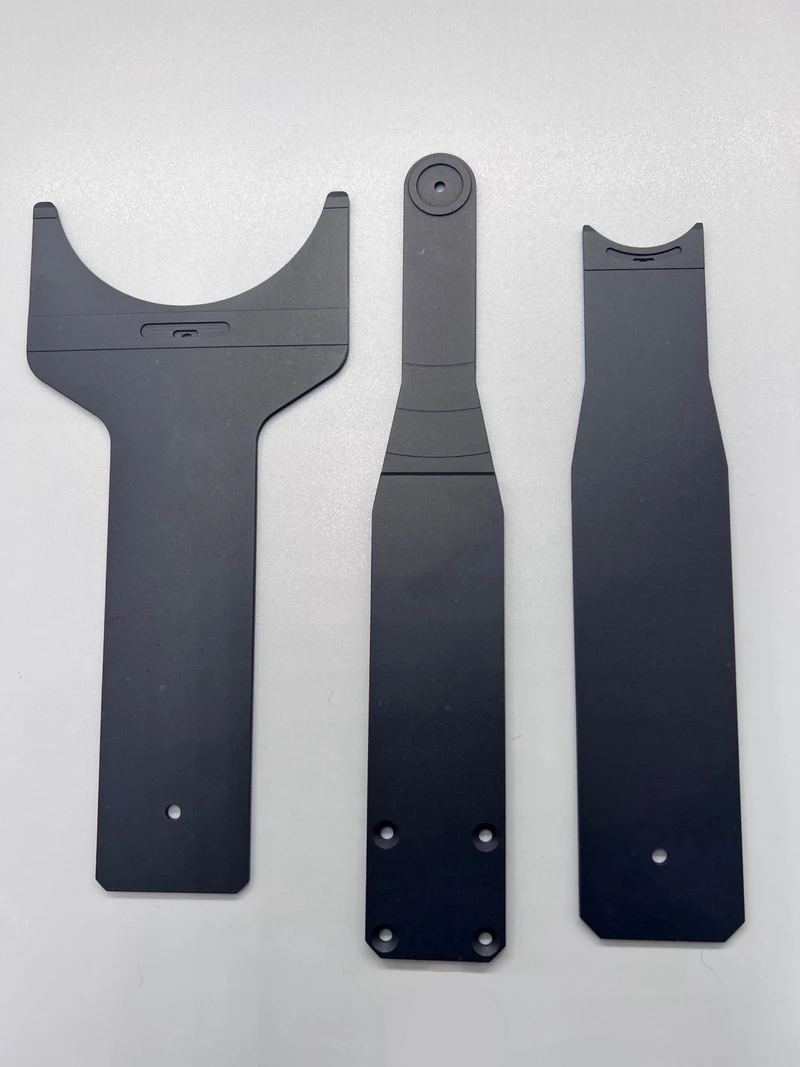
Anti-Static Ceramic Wafer End Effector
Three end-effector profiles — fork, paddle and straight blade — machined from bulk Anti-Static Ceramic. The 10⁷–10⁸ Ω·cm dissipative resistivity belongs to the material itself, not a surface layer, so it runs unbroken to the wafer-contact edge on every profile shown here.
→ See Wafer End Effectors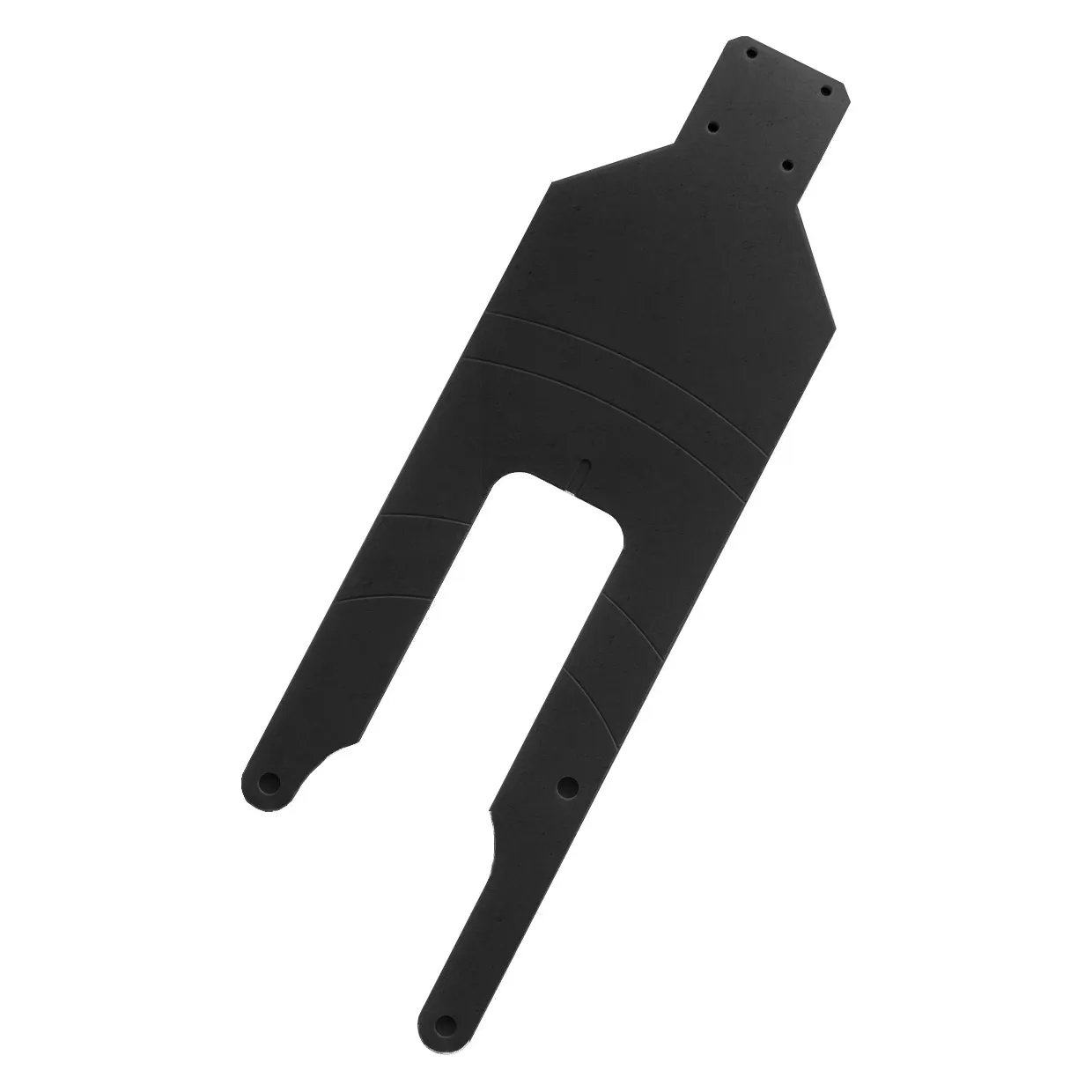
ATC Wafer End Effector — Offset Fork
A three-hole mounting plate at the robot-arm end, an L-bend shaft, and a forked foot with an off-center hole at the wafer-contact end. The offset lets the blade reach around a cassette or chamber feature while the bolted end stays rigid; machining the whole blade from one ESD-safe ceramic blank leaves no bonded strip or coating seam where the dissipation path — or the wafer edge — could get damaged first.
→ See Wafer End Effectors