Ceramic Injection Molding

Available Materials for Ceramic Injection Molding

Physical properties of LONGYI's production CIM grades — our own tested material data.

Property AOW37
Alumina 96%
AOI38
Alumina 99%
ZOI60
Zirconia 99%
ZOB56
Zirconia 99% (Black)
ColorWhiteIvoryIvoryBlack
Density (g/cm³)3.73.86.05.6
Vickers Hardness HV1 (GPa)13.715.212.310.8
Flexural Strength (MPa)3503101000710
Compressive Strength (MPa)2600260018501850
Young's Modulus (GPa)320360200210
Fracture Toughness (MPa·m½)—3–44–53–4
Max Use Temperature (°C)1700170016001600
Volume Resistivity @20°C (Ω·cm)>10¹⁴>10¹⁴10¹³10⁸ *
Dielectric Strength (kV/mm)151511—
Thermal Conductivity @20°C (W/m·K)242933
* ZOB56's 10⁸ Ω·cm is a volume resistivity measurement only — it is not an ESD or static-dissipative grade. ZOB56 is specified for its non-reflective black finish, not for static control.
LONGYI also runs a 99 / 99.5% ultra-high-purity alumina CIM process (as-molded tolerance ≈ ±0.1 mm) for semiconductor-grade stability. Full property data for this grade is in development — contact us for current capability details.

CIM Tolerance by Alumina Grade

94–96% (AOW37)99 / 99.5%
Primary marketEuropean equipment builders — maximum insulation resistanceSemiconductor industry — material stability & machinability
As-molded CIM tolerance±0.3 mm±0.1 mm
Draft angle requiredYes — refined by precision CNC/grindingYes — refined by precision CNC/grinding
Typical downstream stepMetallization + nickel plating + vacuum brazingPrecision machining to final drawing tolerance

Ceramic Injection Molding (CIM) lets LONGYI produce small, geometrically complex advanced ceramic components — also known as technical ceramics or fine ceramics — at production volumes that machining alone cannot reach economically. Fine alumina and zirconia powders are compounded into a moldable feedstock, injected into precision steel tooling, then debound and sintered to full density, giving net-shape parts with repeatable wall sections, threads, and fine features in a single process.

✓

Net-shape production of small, complex ceramic geometries — thin walls, threads, undercuts

✓

High-volume repeatability once tooling is qualified, at lower per-part cost than full machining

✓

As-molded tolerance from ±0.3 mm (94–96% alumina) down to ±0.1 mm (99/99.5% alumina)

✓

Precision CNC and grinding finish the features a mold's draft angle cannot form, to drawing tolerance

Material Capability: Why Zirconia & Alumina Lead in CIM

Alumina (Al₂O₃) — predictable, cost-efficient, brazeable

LONGYI's 94–96% grade (AOW37) molds predictably and accepts metallization and vacuum brazing; our nitrogen-enriched sintering step resists the black-spot discoloration common in re-heated alumina. A 99/99.5% high-purity process tightens as-molded tolerance to about ±0.1 mm.

See Alumina material data →

Zirconia (ZrO₂) — for parts too thin or tough for anything else

At roughly 1000 MPa flexural strength — three times alumina's — Zirconia CIM produces thin-wall, high-toughness parts such as our ceramic dispensing nozzles that would crack in a more brittle material. Our black ZOB56 grade adds a non-reflective finish for vision-guided equipment.

See Zirconia material data →

See the Full Advanced Ceramics Process

CIM is one of several forming methods LONGYI runs in-house, alongside dry pressing, isostatic pressing, and precision machining.

Manufacturing Overview

Get to Know LONGYI

Years of production experience turning customer drawings into technical ceramic components, from prototype through volume.

About Us

Frequently Asked Questions

Q1

What is Ceramic Injection Molding (CIM)?

A

Ceramic Injection Molding (CIM) is a net-shape manufacturing process that mixes fine ceramic powder with a binder into a moldable feedstock, injects it into a metal tool, then removes the binder and sinters the part to full density — used where a ceramic component is too small, too complex, or too high in volume to make economically by machining alone.

Q2

Why are Zirconia and Alumina LONGYI's main CIM materials?

A

Alumina's 94–96% and 99/99.5% powder systems are well characterized and mold predictably, covering most insulation needs at low cost. Zirconia's high flexural strength and low modulus let CIM produce thin-wall, net-shape parts — such as our ceramic dispensing nozzles — that would crack in a more brittle ceramic. Both are high-volume, production-proven CIM systems at LONGYI.

Q3

What tolerance can LONGYI hold with CIM?

A

As-molded, our 94–96% Alumina grade holds about ±0.3 mm and our 99/99.5% Alumina grade about ±0.1 mm. Every CIM tool also needs a draft angle, so sharp corners, flat faces, and tight bores that the mold cannot form are finished afterward with in-house precision CNC and grinding to the drawing's final tolerance.

Q4

Which industries use LONGYI's CIM parts?

A

Semiconductor, medical, fiber optic, and precision industrial automation — most often for small insulating or wear parts such as dispensing nozzles, connectors, and sensor housings.

Q5

Is "ceramic injection molding" the same as "technical ceramics injection molding" or "fine ceramics injection molding"?

A

Yes. Advanced ceramics, technical ceramics, and fine ceramics are regional names — used in North America/Taiwan, Europe, and Japan respectively — for the same family of engineered ceramic materials. The injection molding process is identical regardless of which term a customer's market uses.

Made with CIM — Our Products

LONGYI ceramic injection molded ellipse-orifice dispensing nozzle

Dispensing Nozzle — LONGYI's Flagship CIM Part

Precision fluid-dispensing nozzles are one of the clearest examples of what CIM does well: a small, thin-walled part with a tightly controlled internal orifice, produced to repeatable tolerance at production volume. LONGYI molds these in both alumina and zirconia depending on the wear and strength requirement.

View Dispensing Nozzle specifications →
LONGYI zirconia ceramic dispensing nozzle fitted with a stainless steel (SUS) sleeve

Zirconia Nozzle with Stainless Steel Fitting

A customer-developed nozzle pairing a zirconia ceramic tip with a stainless steel (SUS) mounting sleeve — zirconia's near-metal thermal expansion makes it well suited to this kind of ceramic-to-metal assembly.

See Zirconia material data →

These are two examples from LONGYI's CIM production — every part is engineered to the customer's drawing rather than sold as a catalog item.

Alumina in CIM: predictable, cost-efficient, brazeable

Alumina is LONGYI's highest-volume CIM material because its two production grades cover almost every insulation requirement:

AOW37 (94–96%) — the grade European equipment builders specify when maximum electrical resistance is the priority; molds to ±0.3 mm as-molded, and accepts metallization, nickel plating, and vacuum brazing.
99 / 99.5% high-purity alumina — LONGYI's newer process, favored by semiconductor customers for material stability and machinability; tightens as-molded tolerance to about ±0.1 mm.
A known industry defect in re-heated alumina — visible black-spot discoloration after brazing — is addressed in LONGYI's process with a nitrogen-enriched sintering step for better material bonding.
LONGYI's own helium leak testing on brazed alumina assemblies runs consistently below 1.0×10⁻⁹ mbar·l/s, supporting vacuum-tight and hermetic applications.

Zirconia in CIM: strength where alumina would crack

At roughly three times alumina's flexural strength with a near-metal coefficient of thermal expansion, Zirconia CIM reaches geometries alumina cannot survive:

ZOI60 (ivory, 99%) — structural grade, 1000 MPa flexural strength, for the thinnest walls and highest-load features.
ZOB56 (black, 99%) — same CIM process, formulated for a non-reflective black finish rather than static control; specified when a part must stay visible to a camera or vision-guided system, such as a nozzle tip in an automated dispensing line.
Zirconia's CTE is the closest in LONGYI's material range to metal, which is why it is the default choice for CIM parts fitted or brazed to a metal housing.
Every CIM tool still needs a draft angle; features the mold geometry cannot form — sharp edges, flat faces, tight bores — are finished in-house by precision CNC and grinding to the drawing's final tolerance.

Choosing between the two

As a starting rule of thumb: choose Alumina when electrical insulation and cost are the priority and the geometry is moderate; choose Zirconia when the part is thin, slender, threaded, or will be fitted to metal and cannot risk cracking. Send us your drawing and we'll confirm the right grade for your application.

Parts Gallery — Ceramic Injection Molded Components

White zirconia ceramic sleeve with ground stepped outer diameter
Ivory zirconia (ZOI60) sleeve — CIM-molded, then precision ground to a stepped outer diameter.
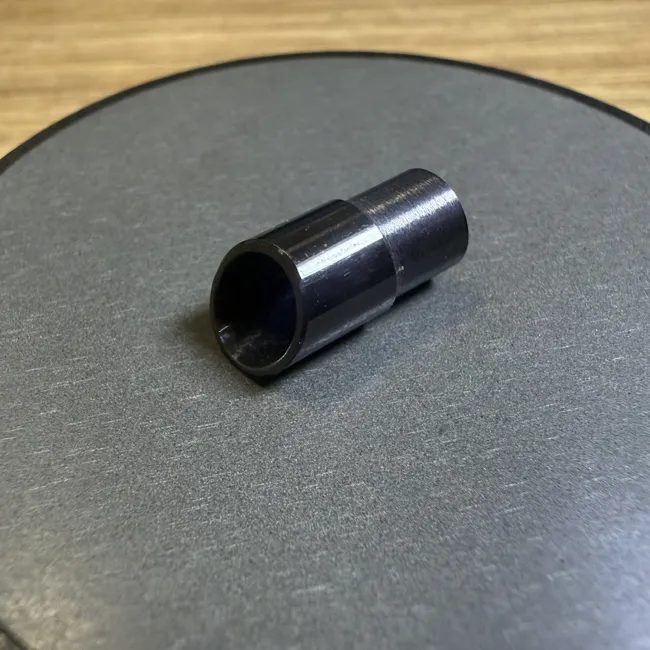
Black zirconia ceramic sleeve with ground stepped outer diameter
Black zirconia (ZOB56) sleeve — non-reflective finish for vision-guided handling.
Zirconia ceramic precision tube molded by CIM
Zirconia precision tube — CIM-molded and ground to final bore tolerance.
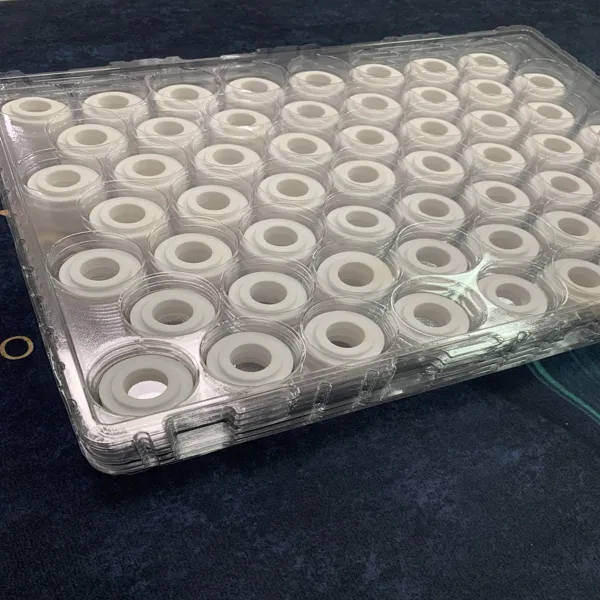
Alumina ceramic insulator produced by injection molding
Alumina ceramic insulator — high-volume CIM production for electrical insulation.

Contact Us

Contact Form EN 2026
➤