
One Porous Ceramic, Engineered for Each Station
The work holding chuck brings porous ceramic suction to the machine shop. The rest of the family is tuned for wafers, dicing, grinding and air bearings.
From Mounting to 0.02 mm Parallelism
Scroll through the five things that decide how much accuracy you get out of the chuck.
Flat-on-Flat Mounting
The porous ceramic plate and the granite base are each precision-ground flat, then bolted at the four corners — so tightening pulls the plate straight down without twist. The assembled face becomes datum A.

Vacuum Zoning
Plates from 300×250 mm are split into 2 or 4 zones, each with its own ON/OFF switch to suck or blow — so one chuck holds small, medium and full-size parts at full strength.

Protect the Exposed Surface
Cover open pores with blanking plates, or set exposed zones to a light blow so coolant and chips are pushed away. With the pump off, a full blow-off lifts particles clear.

Rework, Not Replace
A particle-loaded face is re-cut by diamond-wheel grinding or CNC milling — taking only about 0.005 mm over 650 mm — to expose fresh open pores and return it to flat.

Datum A → 0.02 mm Parallelism
Seat a correctly prepared datum face on the chuck under vacuum and the opposite face machines parallel to about 0.02 mm — often removing the grinding operation entirely.
 01 / 05
How to Prepare the Datum A Face
If the seating face is genuinely flat and drawn fully down onto the chuck, the part comes off the machine at around 0.02 mm parallelism straight from cutting. It only works if datum A was prepared correctly.
- !Never press down from aboveTop-down clamping deflects the part while you cut it; it looks flat on the machine, then springs back on release.
- 1Grip from the sides onlyHold the workpiece on its side faces so the top surface stays completely free and unloaded.
- 2Set a dial indicator on topPlace it on the top surface before you take the clamp to final tightness.
- 3Tighten until the needle just movesThe slight upward bulge confirms the part is gripped — not merely touched, not over-crushed.
- 4Machine that faceHeld this way, the surface you cut is the flattest one you can produce: your true datum A.
- 5Seat datum A on the chuckApply vacuum; with full-surface contact the opposite face machines parallel to about 0.02 mm — no grinding pass.
The mistake we see most often: clamping the part from above. Downward pressure deflects the workpiece while it is cut, and the datum is lost the moment the clamp is released.
C-PRO-GB Series — Porous Ceramic on Granite
The four most-used standard sizes, from small fixtures to large machine-table plates; the full range runs up to 1200×800 mm. The size code is the working area in centimetres (C-PRO-GB-L-W). 2D drawings are in the download section.
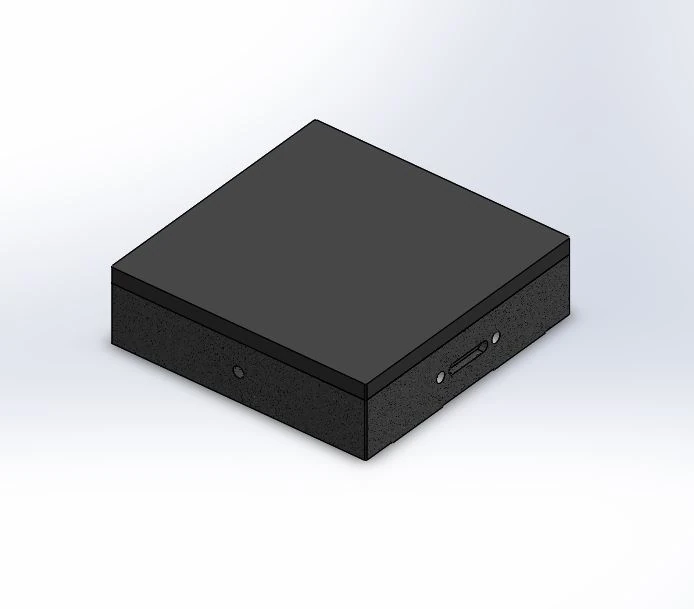 1 ZONE
C-PRO-GB-10-10
Compact block chuck for small parts, fixtures and inspection stations.
 1 ZONE
C-PRO-GB-20-20
Mid-size square chuck for general milling, grinding and engraving work.
 2 ZONES
C-PRO-GB-30-25
Large-area chuck for panels, plates and multi-part holding — two independent vacuum zones.
 4 ZONES
C-PRO-GB-40-30
Large machine-table plate for big or multiple workpieces in one setup — four independent zones.
Every Standard Size, Drawn to Scale
Standard Models — Full Specifications
| Item No. | L×W (mm) | T (mm) | Flatness (mm) | Zones | Vacuum Ports | Vacuum Fitting |
|---|---|---|---|---|---|---|
| C-PRO-GB-10-10 | 100 × 100 | 29 | 0.002 | 1 | 1 | SCPC8-01/02 |
| C-PRO-GB-20-20 | 200 × 200 | 29 | 0.005 | 1 | 1 | SCPC8-01/02 |
| C-PRO-GB-20-20-4S | 200 × 200 | 29 | 0.005 | 1 | 1 | SCPC8-01/02 |
| C-PRO-GB-30-25 | 300 × 250 | 29 | 0.008 | 2 | 2 | SCPC8-01/02 |
| C-PRO-GB-40-30 | 400 × 300 | 32 | 0.010 | 4 | 4 | SCPC10-02/03 |
| C-PRO-GB-60-30 | 600 × 300 | 35 | 0.012 | 4 | 4 | SCPC10-02/03 |
| C-PRO-GB-100-100 | 1000 × 1000 | 60 | 0.015 | 4 | 4 | SCPC12-03/04 |
| C-PRO-GB-120-80 | 1200 × 800 | 60 | 0.020 | 4 | 4 | SCPC12-03/04 |
All grades: open porosity 40–45%, plate-to-base parallelism 0.01 mm. Matching LONGYI ceramic vacuum fittings are SCPC8 / SCPC10 / SCPC12 by size. Custom outlines and thicknesses are made to order.
C-PRO-GB-20-20-4S (magnetic-mount)
A 200×200 mm version with four magnetic stainless-steel corners, so the vacuum chuck itself can be located and held on a magnetic chuck table — convenient for surface grinders that already run one. Drop it on, place small parts freely on the surface and start grinding — no re-clamping between parts.
Add-on Parts for C-PRO-GB-20-20
Optional accessories that follow standard CNC fixturing practice — design drawings available on request:
Built by Machinists, Not on Paper
Developed by engineers with 10+ years of hands-on CNC milling and grinding, and proven first in our own aluminium-alloy and plastic part production — with chips, coolant and continuous cutting. The rule is simple: as long as the part's seating face is flat, set-up is fast and the result is excellent flatness and parallelism.
Where it earns its place
Workpieces it holds
Suits parts that clamps would bend or mark and that magnets cannot hold — the flatter and thinner the part, the bigger the benefit.
When the Part Is Too Warped for Pores Alone
Some parts arrive too bowed for a porous surface alone — air leaks in through the gap and the chuck runs out of flow, not pressure. For these, the chuck is built with a second, high-flow vacuum circuit.
Large holes pull the part down. Porous ceramic holds it flat.
One chuck, two separate vacuum circuits. Drilled through-holes run to their own high-flow line (A); the porous ceramic sits over its own vacuum chamber on a second line (B). Each does the job the other cannot.
- 1A badly warped part is placedIts edges sit far above the surface. Air leaks in through the gap, so the pores alone cannot build enough pull — raising vacuum doesn't help, the chuck runs out of flow.
- 2Stage 1 · Line A pulls it downThe large drilled holes on the high-flow line move a lot of air fast and drag the raised areas down onto the ceramic surface.
- 3Stage 2 · Line B holds it flatOnce the part is seated, vacuum switches to the porous ceramic. Suction spread across the whole contact area holds it flat — without pulling the material into each hole the way a hole-only chuck does.
Specifications, Materials & Compatibility
Values are representative; actual specifications are set to your process, workpiece and machine requirements.
| Specification | Details |
|---|---|
| Product Type | Porous ceramic work holding vacuum chuck (block form) |
| Suction Surface | Porous Ceramic (PC) — insulative; anti-static (ESD) grade optional |
| Base | Granite (GB) — high flatness and vibration damping |
| Standard Sizes | 100×100 up to 1200×800 mm (8 standard) + custom |
| Thickness | 29–60 mm (increases with size) |
| Surface Flatness | 0.002–0.02 mm (tighter on smaller plates) |
| Parallelism (plate to base) | 0.01 mm — assembled ceramic face to granite base |
| Parallelism (machined part) | 0.02 mm typical on a correctly prepared datum face |
| Open Porosity | 40–45% |
| Pore Size | 2–100 µm (selectable) |
| Mechanical Strength | ≥ 150 MPa (porous layer) |
| Typical Suction Flow | 40–100 L/min |
| Vacuum Zoning | 1 zone (≤200×200), 2 zones (300×250), 4 zones (400×300 and up); each zone switched suck / blow |
| Vacuum Fittings | LONGYI ceramic connectors — SCPC8 / SCPC10 / SCPC12 by size |
| ESD Resistivity | 10⁶–10⁹ Ω (optional ESD grade) |
| Surface Finish | Precision ground; re-grindable for reconditioning |
| Custom Design | OEM/ODM — build from drawing or sample |
Porous Ceramic
High-rigidity microporous ceramic with fine, uniform pores (40–45% open porosity) — the flattest holding surface and most even suction. Insulative standard grade.
Material data → ATCAnti-Static Ceramic
Porous ceramic tuned to 10⁶–10⁹ Ω surface resistivity to dissipate static safely — for ESD-sensitive parts and cleanroom automation.
Material data →Pore Size Options (µm)
Finer pores give a smoother face and less print-through; coarser pores move more air for warped or partly covered parts.
Equipment Compatibility & Custom Builds
What Changes on the Machine
LONGYI supports work holding customers with selection, machine-compatibility assessment, OEM/ODM manufacturing, accessory drawings, reconditioning and engineering support — from a single fixture chuck to a full production set.
Holds without distortion
Full-surface suction keeps thin parts flat where clamps would bend them.
Holds non-magnetic parts
Glass, ceramic, plastic and aluminium that magnetic chucks cannot grip.
No clamp marks
The whole underside is supported, leaving the part surface clean and fully accessible.
Skip a grinding operation
A correctly seated part machines to 0.02 mm parallelism directly, removing a downstream step.
Flexible zoning
Independent zones hold small or mixed parts without wasting vacuum on empty area.
Better accuracy, longer tool life
A flat granite-based reference plane improves repeatability, and worn chucks are re-trued instead of replaced.
Part size and material, machine and table, flatness target, zoning and ESD — or a sample chuck to copy or recondition.