
Alumina Ceramic (Al₂O₃) – Density, Hardness & Thermal Conductivity
Al₂O₃ · 氧化鋁 · LONGYI grades AOW37 / AOI38 / AOI39 / AOI393
Alumina is the most widely used technical ceramic in industry — advanced ceramics, technical ceramics and fine ceramics are three regional names for the same family of materials. Measured on our own test pieces, alumina density runs from 3.7 g/cm³ at 96% purity to 3.93 g/cm³ at 99.7%, Vickers hardness HV1 from 13.7 to 16.8 GPa, and thermal conductivity from 24 to 32 W/(m·K) across the same four grades. Every number on this page is LONGYI test data for the grades we actually machine — AOW37, AOI38, AOI39 and AOI393 — not a figure copied from a catalogue. All four are formed, sintered and finished in Taiwan, outside the China supply chain, as an OEM / ODM manufacturer building to your drawing.
Alumina Ceramic Properties at a Glance — Density, Hardness and Thermal Conductivity
Alumina is the baseline with no weak spot — and four rungs to climb.
Alumina wins no single category outright, but across strength, hardness, service temperature and insulation it is never the weakest either. At the lowest cost of any technical ceramic it delivers 13.7–16.8 GPa hardness, 2600–2930 MPa compressive strength, insulation up to 1×10¹⁵ Ω·cm and 1700 °C service temperature in one material family. What the four grades add is a ladder: purity buys density, hardness, stiffness and resistivity in measured steps, so you pay only for the rung the part actually needs. That is why the cheapest path through material selection is to ask "is alumina enough, and at which purity?" first, and only change material where a single property genuinely falls short. The honest limits: thermal shock resistance stays at 200 °C across all four grades, and fracture toughness falls as purity rises — 3–4 MPa·m½ at 99% and 99.5%, but 2.5–3.5 at 99.7%. Alumina is not the answer for thin walls, sharp corners or rapid quenching at any purity.
How Alumina Compares
Seven properties that decide most selections. Alumina holds the upper middle of the first six — which is exactly the point — and is frankly last on thermal shock.
Markers are spaced evenly by rank, not to linear scale. Alumina is shown as a range across its four grades where purity changes the number — density 3.7 g/cm³ (AOW37) to 3.93 g/cm³ (AOI393), hardness 13.7 to 16.8 GPa, thermal conductivity 24 to 32 W/(m·K), flexural strength 310 to 350 MPa — and is placed by the grade that decides the comparison. On the resistivity bar alumina is shown at AOI393, 1×10¹⁵ Ω·cm, its highest grade. Thermal shock and maximum service temperature are identical across all four grades. The other materials are shown at their structural grade: Zirconia ZOI60 · Silicon Carbide SCB32 · Silicon Nitride (structural grade) · Aluminum Nitride ANG34 · Boron Nitride BN-T1800 · Porous Ceramic PA series · Machinable Ceramic. Silicon nitride is absent from the temperature bar because a maximum service temperature has not been measured for it. All values from LONGYI internal property testing in Taiwan.
Full Alumina Ceramic Properties Table — Density, Hardness, Thermal and Electrical Data
Typical values from LONGYI internal testing in Taiwan, four production grades side by side. All four are fully dense with zero water absorption.
| Property | AOW3796% · White | AOI3899% · Ivory | AOI3999.5% · Ivory | AOI39399.7% · Ivory |
|---|---|---|---|---|
| Physical | ||||
| Purity (%) | 96 | 99 | 99.5 | 99.7 |
| Density (g/cm³) | 3.7 | 3.8 | 3.9 | 3.93 |
| Water Absorption (%) | 0 | 0 | 0 | 0 |
| Mechanical | ||||
| Vickers Hardness HV1 (GPa) | 13.7 | 15.2 | 16 | 16.8 |
| Flexural Strength (MPa) | 350 | 310 | 330 | 350 |
| Compressive Strength (MPa) | 2600 | 2600 | 2700 | 2930 |
| Young's Modulus (GPa) | 320 | 360 | 370 | 380 |
| Poisson's Ratio | 0.23 | 0.23 | 0.22 | 0.22 |
| Fracture Toughness (MPa·m½) | — | 3 – 4 | 3 – 4 | 2.5 – 3.5 |
| Thermal | ||||
| Thermal Conductivity at 20 °C (W/(m·K)) | 24 | 29 | 30 | 32 |
| Thermal Expansion 40–400 °C (×10⁻⁶/°C) | 7.2 | 7.2 | 7.2 | 7.2 |
| Thermal Expansion 40–800 °C (×10⁻⁶/°C) | 7.9 | 8.0 | 8.2 | 8.2 |
| Specific Heat (J/(kg·K)) | 880 | 880 | 880 | 880 |
| Thermal Shock Resistance (°C)quenched in water | 200 | 200 | 200 | 200 |
| Max Use Temperature (°C) | 1700 | 1700 | 1700 | 1700 |
| Electrical | ||||
| Dielectric Strength (kV/mm) | 15 | 15 | 17 | 18 |
| Volume Resistivity at 20 °C (Ω·cm) | >10¹⁴ | >10¹⁴ | 1×10¹⁴ | 1×10¹⁵ |
| Volume Resistivity at 300 °C (Ω·cm) | 10¹⁰ | 10¹⁰ | 1×10¹³ | 1×10¹⁴ |
| Volume Resistivity at 500 °C (Ω·cm) | 10⁸ | 10⁸ | 1×10¹⁰ | 1×10¹¹ |
| Dielectric Constantat 1 MHz | 9.4 | 9.9 | 10 | 10.2 |
| Chemical Resistance — weight loss mg/cm² | ||||
| Nitric Acid (mg/cm²)60%, 90 °C, 24 h | — | 0.1 | — | — |
| Sulphuric Acid (mg/cm²)95%, 95 °C, 24 h | — | 0.33 | — | — |
| Caustic Soda (mg/cm²)30%, 80 °C, 24 h | — | 0.26 | — | — |
Values are typical for the stated grade and test condition, not guaranteed minimums. A dash (—) means the property has not been measured for that grade, not that it is zero. The chemical resistance figures were measured on AOI38 only. Final part specification is governed by the approved drawing and order confirmation.
Which Alumina Grade Do You Need?
Purity is a ladder, not a quality scale. Each rung buys something and costs something — these four cards say what.
The volume grade. Its glass phase makes it easier to metallize and braze, and lowers cost per part — and it ties for the highest flexural strength of the four. Choose it for brazed assemblies, bonded joints and higher-quantity parts where cost matters more than hardness.
- Density3.7 g/cm³
- Hardness13.7 GPa
- Thermal Cond.24 W/(m·K)
The workhorse. Higher purity gives 11% more hardness and 13% more stiffness than 96%, at the cost of some flexural strength. It is also the only grade with measured acid and caustic data. Choose it for wear surfaces, plasma-facing parts and anywhere rigidity or purity drives the design.
- Density3.8 g/cm³
- Hardness15.2 GPa
- Thermal Cond.29 W/(m·K)
The balanced rung. It recovers the flexural strength that 99% gives up (330 vs 310 MPa) while adding density, hardness, stiffness and a step up in dielectric strength — and it keeps the 3–4 MPa·m½ fracture toughness that 99.7% starts to lose. The default choice when no single property dominates.
- Density3.9 g/cm³
- Hardness16 GPa
- Thermal Cond.30 W/(m·K)
The top rung. Densest (3.93 g/cm³), hardest (16.8 GPa), stiffest (380 GPa) and the most insulating alumina we make — 1×10¹⁵ Ω·cm at 20 °C and still 1×10¹¹ at 500 °C. The price is toughness: 2.5–3.5 MPa·m½, the lowest of the four. Specify it for isolation and wear, not for impact.
- Density3.93 g/cm³
- Hardness16.8 GPa
- Thermal Cond.32 W/(m·K)
All four grades share the same 1700 °C limit, the same 200 °C thermal shock figure, the same 7.2 ×10⁻⁶/°C expansion at 40–400 °C and the same zero water absorption — so temperature, thermal shock and thermal fit are not the deciding factors between them. Density, hardness, resistivity, toughness and cost are.
Why the Highest Purity Is Not Automatically the Best
Three places where the data does not move the way engineers expect it to.
96% is not the weakest
Flexural strength does not climb with purity. AOW37 at 96% reaches 350 MPa, while 99% drops to 310 and only 99.7% climbs back to 350. The glass phase in the 96% body blunts crack propagation, and it is also what makes that grade the easiest to metallize and braze. If the part is a brazed assembly, 96% is frequently the better engineering choice as well as the cheaper one.
Purity costs toughness
Fracture toughness runs the other way: 3–4 MPa·m½ at 99% and 99.5%, but 2.5–3.5 at 99.7%. Less glass phase and larger grains mean a crack, once started, has less to stop it. For a part with thin sections, sharp internal corners or any impact loading, AOI39 at 99.5% is the safer top rung than AOI393.
Density and resistivity are where purity pays
These are the properties that reward purity without a catch. Density rises 3.7 → 3.93 g/cm³ and volume resistivity >10¹⁴ → 1×10¹⁵ Ω·cm at 20 °C, with the resistivity gap widening as the part heats — at 500 °C, AOI393 holds 1×10¹¹ Ω·cm against 10⁸ for the 96% and 99% grades, a thousandfold difference. Dielectric strength follows, 15 → 18 kV/mm.
Two Forming Routes, Two Markets
Alumina is not one market. The 94–96% range and the 99% and above range are bought by different engineers for different reasons, and they are made and finished differently. We supply both.
Across the industry this range is treated as one application family. European equipment builders in particular specify it as their standard insulating ceramic — the part is chosen for electrical isolation first, mechanical duty second. Most parts in this range are ceramic injection moulded, which is what makes them economical at volume.
- Typical formingInjection moulding (CIM)
- As-moulded tolerance±0.3 mm
- Draft angleRequired by the tool
- Usual finishingMetallize + Ni plate + braze
The most widely used material in precision ceramic components, and the most common alumina in semiconductor equipment — chosen because it is dimensionally stable and machines predictably, which is what matters when a part has to hit micron tolerances repeatably. Full property data for AOI39 and AOI393 is published in the table above and in the downloadable data sheet.
- Typical formingInjection moulding (CIM)
- As-moulded tolerance±0.1 mm
- Draft angleRequired by the tool
- Usual finishingPrecision machining to final spec
Where We Are Different
Three problems that are normal in moulded alumina, and what we do about them.
We machine past the mould's limits
A moulding tool imposes draft angles and holds only ±0.3 mm at 94–96%, ±0.1 mm at 99% and above. Those are limits of the tool, not of the material. We take the moulded blank and finish the features that matter by precision grinding and CNC — square walls where the tool needed draft, and tolerance where the drawing demands it. You get injection-moulding economics with machined-part accuracy.
No dark spots after the second firing
Alumina in this range is prone to dark speckling when it is fired a second time — and those spots surface exactly where it hurts, on the ceramic exposed after vacuum brazing. Buyers of vacuum-tight assemblies routinely reject on discolouration alone. Our current sintering route introduces nitrogen during firing, improving how the body consolidates and suppressing the discolouration mechanism.
Made in Taiwan, outside the China supply chain
Forming, sintering, diamond grinding, CNC, metallizing and brazing all happen in our own plant in Taoyuan, Taiwan. For semiconductor and defence-adjacent customers who now have to document where a part was made, that is a procurement requirement rather than a marketing line. Brazed alumina-to-metal assemblies are helium leak tested below 1.0×10⁻⁹ mbar·l/s, with joints rated for 500 °C bakeout.
What Alumina Ceramic Is Used For
Semiconductor equipment is the largest single use, but the same four grades cover wear, vacuum and high-temperature work.
Semiconductor Equipment
- Wafer chuck and fixture base plates
- Vacuum chamber insulators and liners
- Electrical feedthroughs and standoffs
- Plasma-facing rings and shields
- Process tube and furnace components
Wear & Fluid Handling
- Pump plungers, valve seats and sleeves
- Wear liners and material guides
- Textile and wire guide components
- Nozzles for abrasive media
High Temperature & Lab
- Thermocouple protection tubes
- Laser tubes and insulating washers
- Welding and brazing fixtures
- Crucibles and setter plates
When Alumina Is the Wrong Choice
We would rather tell you the limits up front than have you machine a part that fails in service. Each of these is a real boundary in the data above.
Thin walls, slender sections, threads or sharp internal corners will chip, and raising purity makes it worse rather than better — fracture toughness falls to 2.5–3.5 MPa·m½ at 99.7%. At 310–350 MPa flexural strength alumina has roughly a third of the strength of zirconia (ZrO₂) at 1000 MPa, or of silicon nitride (Si₃N₄) at 1020 MPa — and silicon nitride also carries the highest fracture toughness in the range, 6–7 MPa·m½.
For heavy abrasive wear, or for large moving parts where deflection must stay sub-micron, even AOI393 at 16.8 GPa hardness and 380 GPa stiffness is not the ceiling. Silicon carbide (SiC) reaches 22–23 GPa and 430–440 GPa, giving far higher specific stiffness at a lower density of 3.1–3.3 g/cm³.
If the part has to insulate electrically and conduct heat away from a die, the thermal conductivity of alumina — 24–32 W/(m·K) — is not enough at any purity. Aluminum nitride (AlN) delivers 220 W/(m·K), around 7× higher, while keeping >10¹⁴ Ω·cm resistivity, and its 4.6 ×10⁻⁶/°C expansion is close enough to silicon to survive thermal cycling under a bonded chip.
Alumina survives a 200 °C water quench, the lowest thermal shock figure in the range, and buying a higher purity does not improve it — all four grades sit at 200 °C. For repeated rapid heating and cooling, silicon nitride (Si₃N₄) is in a different class at 800–900 °C — four times alumina and twice silicon carbide (400 °C); zirconia reaches 300 °C.
1×10¹⁵ Ω·cm is the best insulation we make in alumina — and a liability against a wafer or a bare die, because charge accumulates and then releases in one damaging event. Use anti-static ceramic (ATC) at 10⁷–10⁸ Ω·cm instead, where charge bleeds away continuously.
Alumina has zero water absorption at every purity, so vacuum can only be applied through drilled holes or machined grooves — which leaves marks on thin or fragile work. Porous ceramic (PC) carries open porosity with micron-scale pores, pulling vacuum evenly across the entire working face.
Alumina must be formed, sintered and then diamond-ground, so prototypes take weeks. For a one-off, a design still in revision, or a part needed in days, machinable ceramic is cut directly from stock with conventional tooling — no sintering, no shrinkage, no shrink compensation.
Parts We Make in Alumina
Alumina is used as the structural base, insulator or wear surface in several of our standard product lines.
From Material to Finished Part
Choosing alumina is the easy half. Whether the geometry can actually be produced — and held to tolerance — depends on forming, sintering, grinding and measurement.
Advanced Ceramics Manufacturing
Alumina parts start as pressed or injection-moulded green bodies, shrink roughly 15–20% during sintering, and are then finished by diamond grinding and lapping to reach final tolerance and flatness. Understanding where that shrinkage is absorbed is what decides whether a feature is economical or not.
See our manufacturing processAbout LONGYI Precision Technology
We are a Taiwan-based advanced ceramic manufacturer, not a trading house. Forming, sintering, CNC and 5-axis machining, brazing, metallization and final inspection are handled in-house in Taoyuan, which is what makes true OEM / ODM work — build to drawing, build to sample — practical at low volume and outside the China supply chain.
About LONGYI Precision TechnologyNot Sure Which of the Four Grades Fits Your Part?
Send a drawing, a sample, or just describe the operating condition — temperature, load, media, voltage, cleanliness class. Our engineers will come back with a grade recommendation and a quotation.
Talk to Our EngineersFrequently Asked Questions
What is alumina ceramic?
Alumina ceramic is a sintered aluminium oxide (Al₂O₃) body used where a part has to insulate electrically, resist wear, or hold its shape at high temperature — the most widely used technical ceramic in industry. It is specified by purity: 96% for brazed and moulded assemblies, 99% and above where density, hardness, stiffness, resistivity and plasma resistance decide the design.
What is the density of alumina?
Alumina density is 3.7 to 3.93 g/cm³, depending on purity: 3.7 g/cm³ at 96% (AOW37), 3.8 at 99% (AOI38), 3.9 at 99.5% (AOI39) and 3.93 at 99.7% (AOI393). Higher purity means less glass phase and a more completely sintered body, so density rises with purity. All four grades are fully dense with zero water absorption, which is what makes them vacuum-tight. For comparison, that puts alumina heavier than silicon carbide (3.1–3.3 g/cm³) and aluminium nitride (3.4) but much lighter than zirconia (5.6–6).
What is the thermal conductivity of alumina?
The thermal conductivity of alumina is 24 to 32 W/(m·K) at 20 °C: 24 at 96%, 29 at 99%, 30 at 99.5% and 32 at 99.7%. That is high enough to spread heat but far short of a heat-sink material — if the part has to carry heat away from a die, aluminium nitride at 220 W/(m·K) or silicon carbide at 60 W/(m·K) are the alternatives. Specific heat is 880 J/(kg·K) for all four grades.
How hard is alumina ceramic?
Alumina hardness is 13.7 to 16.8 GPa measured as Vickers HV1, rising with purity: 13.7 at 96%, 15.2 at 99%, 16 at 99.5% and 16.8 at 99.7%. That is harder than zirconia (12.3 GPa) and aluminium nitride (10.4 GPa), but below silicon carbide at 22 GPa. Hardness is why alumina survives abrasive wear; it is also why every feature has to be cut with diamond tooling after sintering.
What is the difference between 96% and 99.5% alumina?
99.5% alumina (AOI39) is denser (3.9 vs 3.7 g/cm³), harder (16 vs 13.7 GPa), stiffer (370 vs 320 GPa) and more conductive thermally (30 vs 24 W/(m·K)) than 96% (AOW37). But 96% is not simply the worse material: its glass phase gives it equal flexural strength (350 MPa, against 330 for 99.5%), makes it markedly easier to metallize and vacuum braze, and costs less per part. Pick 96% for brazed and bonded assemblies, 99.5% for wear surfaces, plasma-facing parts and anything where rigidity or purity drives the design.
What is alumina ceramic used for in semiconductor equipment?
In semiconductor equipment alumina is used for wafer chuck and fixture base plates, vacuum chamber insulators and liners, electrical feedthroughs and standoffs, plasma-facing rings and shields, and process tube and furnace components. The reasons are its combination of >10¹⁴ Ω·cm insulation, 1700 °C service temperature, zero porosity for vacuum integrity and predictable machining to micron tolerances. 99% and above is the usual specification because higher purity resists plasma erosion better. Where the part touches a wafer or a bare die, anti-static ceramic is specified instead, because alumina's insulation lets charge build up.
Is "technical ceramics" the same as "advanced ceramics"?
Yes — the term changes with the region, the material does not. Engineers in Europe and the UK say technical ceramics or engineering ceramics (German: Technische Keramik), North America and Taiwan say advanced ceramics, and Japan says fine ceramics. All three describe the same family of high-performance oxide and non-oxide ceramics, alumina included. Ask for either name and you will get the same part from us.
Is higher purity alumina always better?
No, and two properties prove it. Flexural strength does not rise monotonically — 96% reaches 350 MPa while 99% drops to 310 — because the glass phase in the lower-purity body blunts cracks. And fracture toughness falls as purity rises, from 3–4 MPa·m½ at 99% and 99.5% to 2.5–3.5 at 99.7%. Purity reliably buys density, hardness, stiffness and volume resistivity. It does not buy toughness, and it does not buy thermal shock resistance at all.
Which alumina grade has the highest electrical resistivity?
AOI393 at 99.7%, with 1×10¹⁵ Ω·cm at 20 °C and 18 kV/mm dielectric strength. The advantage widens with temperature, which is where it matters: at 500 °C it still holds 1×10¹¹ Ω·cm, against 10⁸ Ω·cm for the 96% and 99% grades — a thousandfold difference. If the part is a hot feedthrough, standoff or chamber insulator, that gap is the reason to pay for the top grade.
What tolerance can you hold on an alumina part?
As-sintered surfaces typically hold around ±1% of dimension because of sintering shrinkage, and as-moulded parts hold ±0.3 mm at 94–96% or ±0.1 mm at 99% and above. Ground and lapped surfaces go far tighter, into the single-digit micron range for flatness and dimension. Tolerance should be specified only on the faces that need it — grinding every surface multiplies cost without adding function.
Do you supply alumina to drawing, and where is it made?
To drawing, and to sample, and it is made in Taiwan. Forming, sintering, CNC and 5-axis machining, metallizing, brazing and final inspection are all handled in our own plant in Taoyuan — outside the China supply chain, which matters to customers who have to document origin. Custom OEM / ODM geometry is our normal work rather than an exception. Send a 2D drawing or a 3D model with the critical dimensions identified.
Explore All LONGYI Ceramic Materials
Ten material families, all manufactured and machined in-house in Taiwan.
Also Known As
alumina density, alumina hardness, thermal conductivity of alumina, alumina ceramic properties, aluminum oxide ceramic, aluminium oxide, Al2O3, Al₂O₃, alumina ceramic, alumina oxide ceramic, 氧化鋁, 氧化铝陶瓷, corundum, sintered alumina, technical ceramics, Technische Keramik, céramique technique, engineering ceramics, advanced ceramics, fine ceramics, 精密陶瓷, 工業陶瓷, 96% alumina, 99% alumina, 99.5% alumina, 99.7% alumina, high purity alumina, white ceramic, ivory ceramic, AOW37, AOI38, AOI39, AOI393, alumina insulator, alumina wear part, technical alumina, engineering alumina, 94% alumina, ceramic injection moulding, CIM alumina, metallized alumina, alumina metallization, nickel plated ceramic, vacuum brazed ceramic, ceramic to metal seal, vacuum tight ceramic, hermetic ceramic, high resistivity ceramic, alumina data sheet, alumina ceramic manufacturer Taiwan
Alumina Parts We Have Made
Production parts in 96% and 99% alumina. Each one is shown because a visible feature of its geometry is doing a specific job — click any photo to enlarge.
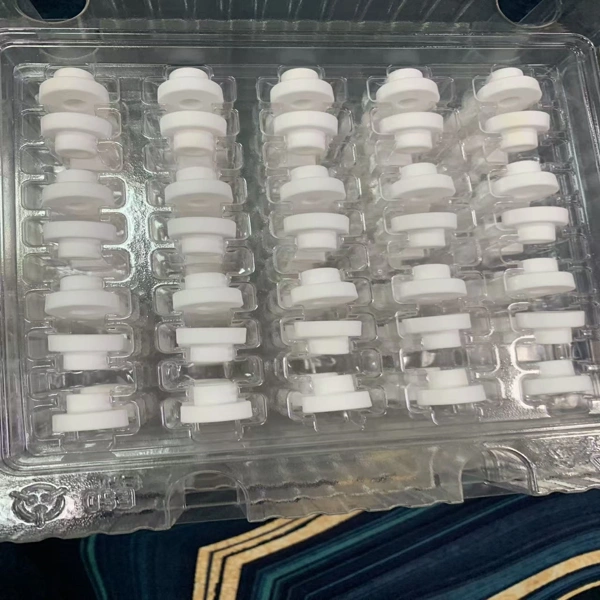
The stepped outer profile is not decoration. Every step adds surface creepage distance between the two ends without adding overall height, so the part holds off a higher voltage in the same stack-up envelope. 96% is specified here because the glass phase makes the part easier to metallize and braze into a metal housing.
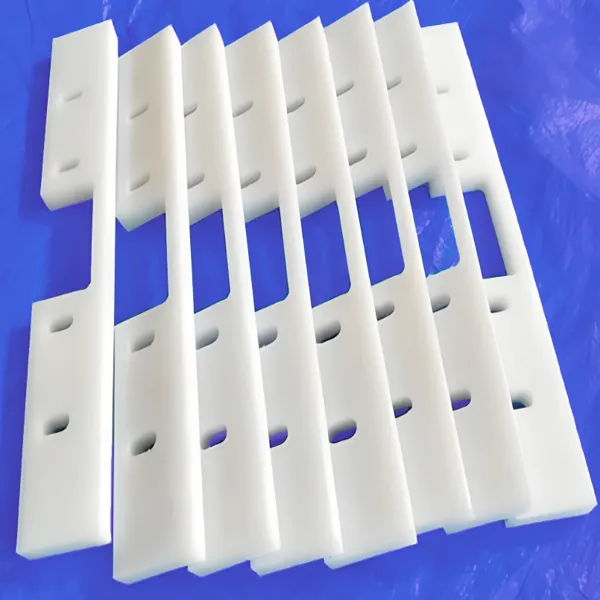
The holes are slots, not circles, because the metal frame this plate bolts to expands 1.5–3× faster than alumina's 7.2–8.2 ×10⁻⁶/°C. The slots let the screws slide as the assembly heats, so thermal cycling does not pull the plate apart. Slot ends are radiused to keep stress off a sharp corner.
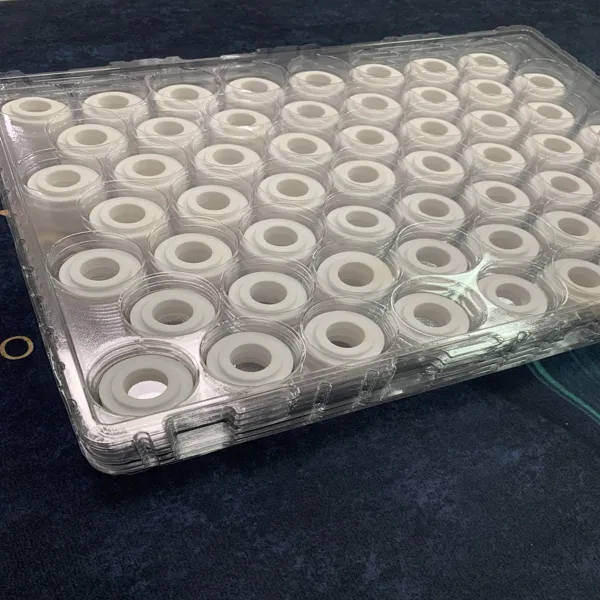
The two raised pads on the top face carry the load on a small, ground contact area, which is what makes the seating plane actually flat in service — a large as-fired face never is. The relief between them also shrinks the area a contamination film can bridge, so the insulation resistance holds up in a dirty chamber.
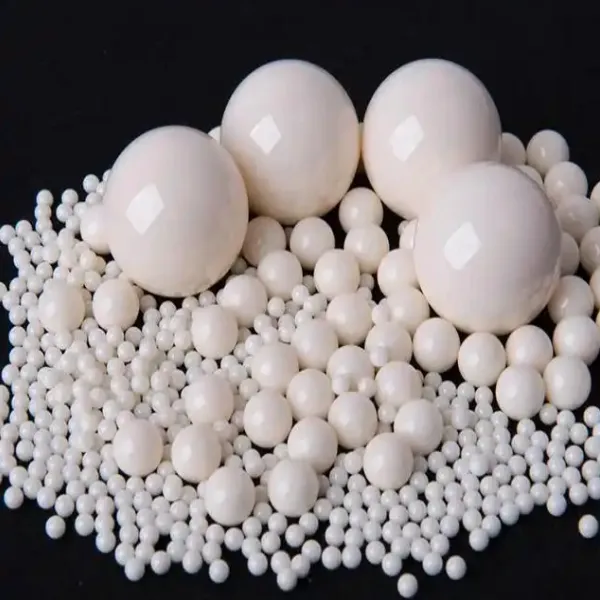
Two reasons these are ceramic and not steel: 15.2 GPa hardness resists the abrasion that destroys a steel ball in slurry, and alumina contains no iron phase — a steel ball grinds iron into whatever it is milling or pumping. Supplied graded by diameter, because a mixed charge grinds unevenly.
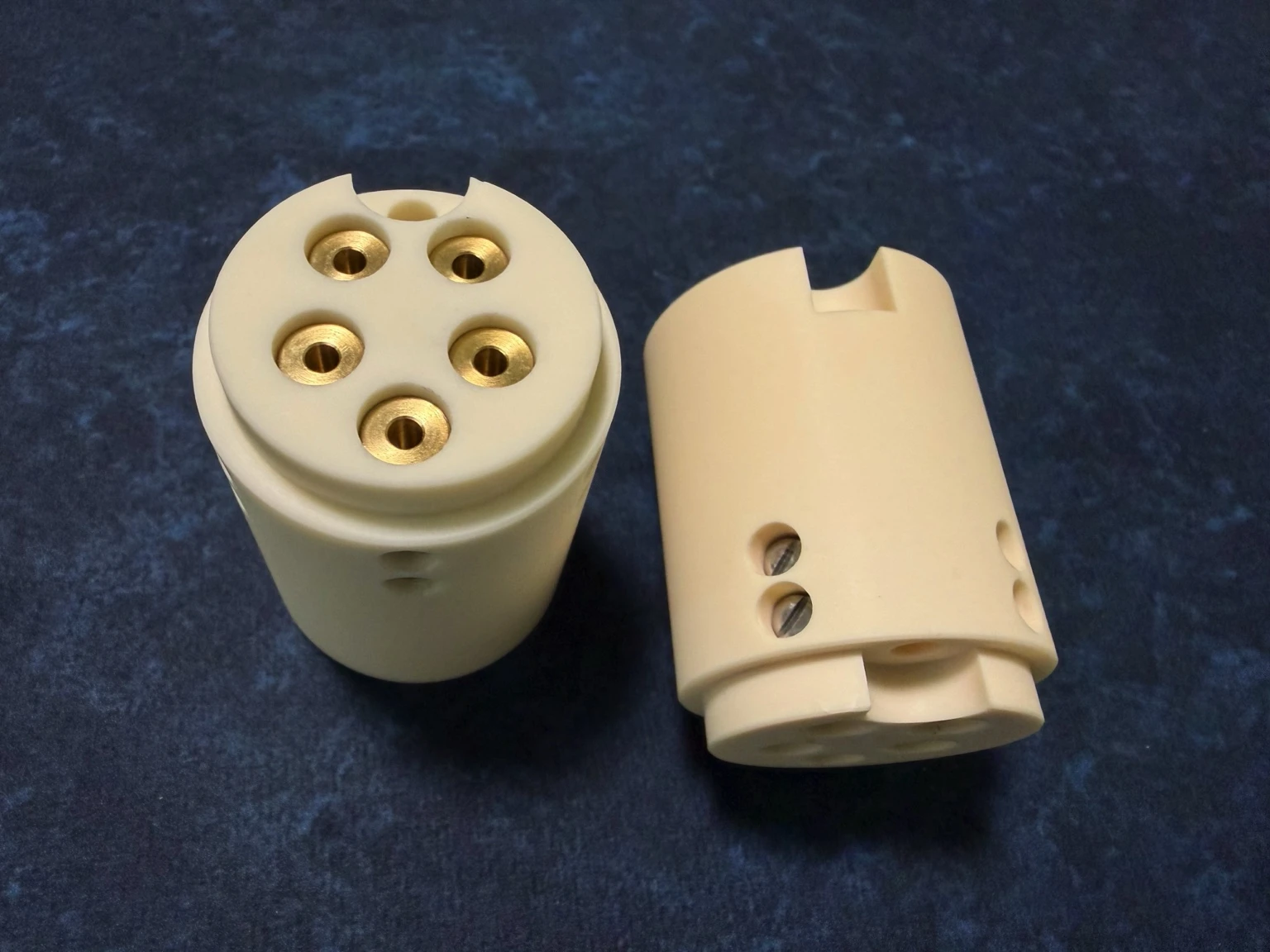
The keyway is mechanical poka-yoke: the body only mates one way round, so pin 1 cannot be inserted into pin 5. Each pin seat is recessed below the face, which forces the creepage path between adjacent circuits to travel through the full thickness of the ceramic instead of skating across a flat surface.
See our ceramic connectors